The Crypto & Fintech Retrieval Readiness Index
By Zion Labs · Published August 4, 2026 · 18 min read
We scored 54 crypto and fintech homepages against our Retrieval Readiness Score on 4 August 2026. None reached retrieval ready. Six return almost no readable text before JavaScript runs. Nine could not be measured at all.
Our July index found access is almost never the barrier here: 95.5% of the sites we could read allow every AI crawler we check. So why are so few crypto and fintech brands named in AI answers? For a handful of very large brands, there is nothing in the document to read.
What did we measure, and when?
One pass, 54 companies, 4 August 2026, from Cloudflare’s network. We fetched each homepage and ran it through the live Retrieval Readiness Score at scoring version 3: nine weighted dimensions, three capping gates. Every dimension score and page signal is published as JSON.
Keeping these three groups apart is the whole basis of the index:
| Group | Companies | What it means |
|---|---|---|
| Ranked | 37 | We fetched and read the page. Every dimension the rubric can measure was measured. The only domains in the ranking. |
| Scored but not ranked | 8 | Enough checks returned to produce a score, but our page fetch did not, so the page level dimensions are missing. Real scores, systematically inflated. |
| Not scored | 9 | Too little returned to publish a number at all. Not a low score. |
Across the 37 ranked domains the mean is 55.4, the median 59, the range 25 to 73, on a scale where 80 is the floor of the top band.
| Band | Range | Ranked companies |
|---|---|---|
| Retrieval-ready | 80 to 100 | 0 |
| Retrievable, with gaps | 60 to 79 | 18 |
| At risk | 40 to 59 | 14 |
| Largely invisible | 0 to 39 | 5 |
None of the 45 domains that produced a score reached 80. The best fully measured score, on this rubric, on this day, was 73.
Which sites return no readable text to an AI crawler?
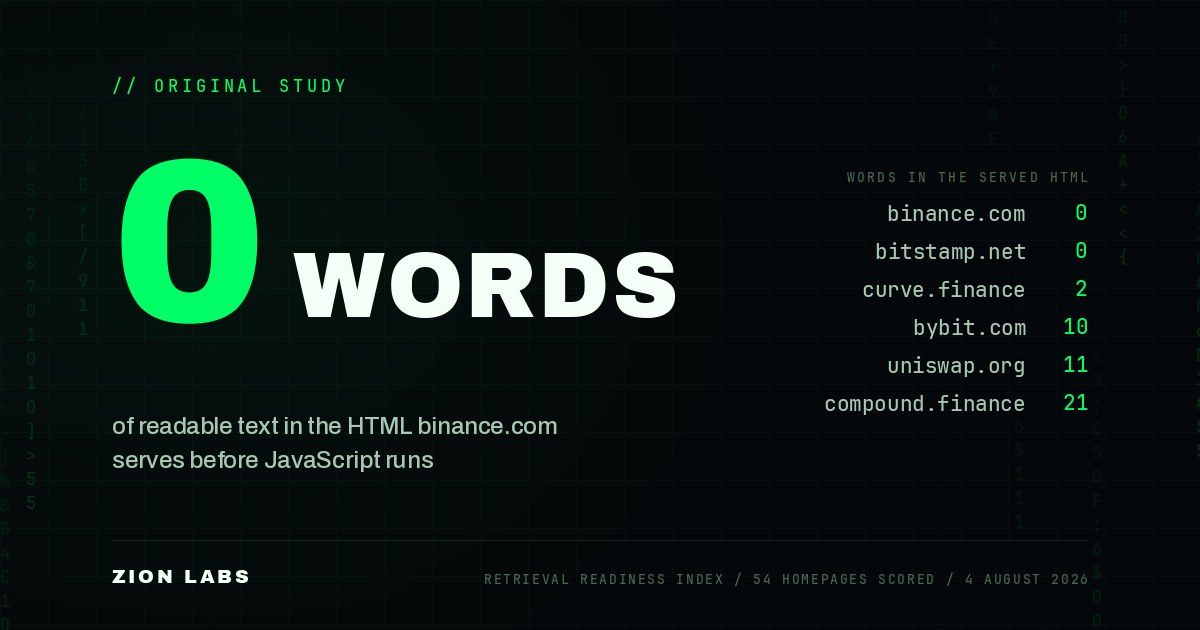
Six of the 54 fail the render gate, which asks whether readable body text exists in the HTML the server sends before any JavaScript executes. GPTBot, OAI-SearchBot, ClaudeBot and PerplexityBot do not run JavaScript, so a page can look perfect in a browser and arrive at an answer engine as an empty div.
| Domain | Segment | Words in the served HTML | Score |
|---|---|---|---|
| binance.com | Centralised exchange | 0 | 25 |
| bitstamp.net | Centralised exchange | 0 | 25 |
| curve.finance | DeFi protocol | 2 | 25 |
| bybit.com | Centralised exchange | 10 | Not scored |
| uniswap.org | DeFi protocol | 11 | 25 |
| compound.finance | DeFi protocol | 21 | 25 |
Binance and Bitstamp returned zero extractable words. Not thin, not short. Nothing. Between them these six cover one of the largest exchanges in the world, one of the oldest, two of the most used decentralised exchanges and a major lending protocol. Every one returned HTTP 200, and all five of the scored domains here register a perfect 100 on Access. The door is open and the room is empty.
This is the most solid finding in the index, because the measurement is the served document itself rather than an inference about it. The render gate caps rather than deducts, which is why five of the six land on exactly 25: nothing downstream rescues a document with no text in it. The sixth, bybit.com, fails the same gate at 10 words but carries no score at all, for the reason two sections down. The gate result is a real measurement. The rest of its measurement is not.
Check any homepage yourself in one line:
curl -s https://yourdomain.com | sed -e 's/<[^>]*>/ /g' | wc -wIf that number is near zero and the site looks fine in Chrome, the content is arriving after JavaScript and most AI crawlers are not seeing it.
Why being unreadable inflates a score, and what we did about it
This is a finding about our own method, and the reason the ranking has 37 rows rather than 45.
Eight domains produced a score without our page fetch succeeding, which leaves Structure, Freshness, Token cost and Time unmeasured. The rubric renormalises over what was measured. That is right in general and not neutral here, because those four are exactly the dimensions this cohort is worst at: Structure averages 28.7, Freshness 21.3, Token cost 27.9. Skip them and what remains is Access at 97.4 plus Time, which almost everybody passes.
| Group | Companies | Mean score |
|---|---|---|
| Scored with a successful page fetch | 37 | 55.4 |
| Scored without a successful page fetch | 8 | 71.1 |
15.7 points, produced by not being readable. A site whose edge turned our fetch away scores better than a site that let us in, purely because the checks it dodged are the hard ones. So these eight keep their scores, which are real measurements of the dimensions that did return, and lose their rank, which would have been unearned. Four would otherwise have placed in the top ten.
| Domain | Segment | Score | Dimensions returned |
|---|---|---|---|
| arbitrum.io | L1/L2 chain | 77 | 3 of 8 |
| coinbase.com | Centralised exchange | 76 | 4 of 8 |
| polygon.technology | L1/L2 chain | 73 | 4 of 8 |
| monzo.com | Neobank / fintech app | 73 | 4 of 8 |
| koinly.io | Crypto tax / accounting | 72 | 4 of 8 |
| cointracker.io | Crypto tax / accounting | 69 | 4 of 8 |
| n26.com | Neobank / fintech app | 66 | 4 of 8 |
| tokentax.co | Crypto tax / accounting | 63 | 4 of 8 |
That is a partial view weighted toward the easy half of the rubric, not evidence that these sites are more retrievable than the ranked domains below them, and several are candidates to fall once their pages can be read. An index that mixes measured and unmeasured rows into one league table rewards being harder to crawl. That is the failure mode we criticise in other people’s readiness indices, and it took a 15.7 point gap in our own data to catch it.
Which sites could we not score, and why does that matter?
Nine of the 54 have no score. Unscored is not a low score. It is not a failure, not a rank and not a band. Our measurement did not complete, and the honest thing to publish is that fact rather than a number.
The scorer refuses a headline figure unless at least three of the four core dimensions return: Access, Extraction, Answerability and Entity Resolution. Below that bar a number is built from whatever happened to succeed, and it fails in the flattering direction the previous section quantifies.
| Domain | Segment | Dimensions returned | What was missing |
|---|---|---|---|
| okx.com | Centralised exchange | 6 of 8 | Extraction, Answerability |
| kucoin.com | Centralised exchange | 6 of 8 | Extraction, Answerability |
| bitfinex.com | Centralised exchange | 6 of 8 | Extraction, Answerability |
| bybit.com | Centralised exchange | 5 of 8 | Access, Extraction, Answerability |
| metamask.io | Wallet | 6 of 8 | Extraction, Answerability |
| plaid.com | Payments / on-ramp | 6 of 8 | Extraction, Answerability |
| revolut.com | Neobank / fintech app | 2 of 8 | Extraction, Answerability, Structure, Freshness, Token cost, Time |
| sofi.com | Neobank / fintech app | 2 of 8 | Extraction, Answerability, Structure, Freshness, Token cost, Time |
| chime.com | Neobank / fintech app | 1 of 8 | Everything except Entity Resolution |
The checks that fail are the ones that need to read the page body: Extraction and Answerability are missing in all nine. In seven of the nine, the site served us its robots.txt quite happily while turning the content fetches away.
That cuts both ways. An edge rule refusing an automated request from an unfamiliar network may refuse an answer engine’s crawler on the same grounds, whatever robots.txt permits. It may equally let named AI user agents straight through. We measured neither, so we claim neither. These nine are recorded as unmeasured and excluded from the ranking, the mean, the median and the bands.
The full index
The 37 domains whose pages we read. The unranked eight and the unscored nine are in the tables above and do not appear here.
| # | Domain | Segment | Score | Band | Note |
|---|---|---|---|---|---|
| 1 | starlingbank.com | Neobank / fintech app | 73 | Retrievable, with gaps | |
| 2 | ethereum.org | L1/L2 chain | 72 | Retrievable, with gaps | |
| 3 | banxa.com | Payments / on-ramp | 71 | Retrievable, with gaps | |
| 4 | ledger.com | Wallet | 71 | Retrievable, with gaps | |
| 5 | transak.com | Payments / on-ramp | 69 | Retrievable, with gaps | |
| 6 | base.org | L1/L2 chain | 67 | Retrievable, with gaps | |
| 7 | cardano.org | L1/L2 chain | 67 | Retrievable, with gaps | |
| 8 | aave.com | DeFi protocol | 65 | Retrievable, with gaps | |
| 9 | bitpay.com | Payments / on-ramp | 64 | Retrievable, with gaps | |
| 10 | gemini.com | Centralised exchange | 64 | Retrievable, with gaps | |
| 11 | circle.com | Payments / on-ramp | 63 | Retrievable, with gaps | |
| 12 | moonpay.com | Payments / on-ramp | 63 | Retrievable, with gaps | |
| 13 | optimism.io | L1/L2 chain | 63 | Retrievable, with gaps | |
| 14 | synthetix.io | DeFi protocol | 63 | Retrievable, with gaps | |
| 15 | avax.network | L1/L2 chain | 62 | Retrievable, with gaps | |
| 16 | crypto.com | Centralised exchange | 61 | Retrievable, with gaps | |
| 17 | stripe.com | Payments / on-ramp | 61 | Retrievable, with gaps | |
| 18 | solana.com | L1/L2 chain | 60 | Retrievable, with gaps | |
| 19 | wise.com | Neobank / fintech app | 59 | At risk | |
| 20 | ramp.network | Payments / on-ramp | 58 | At risk | |
| 21 | trezor.io | Wallet | 57 | At risk | |
| 22 | blockpit.io | Crypto tax / accounting | 56 | At risk | |
| 23 | near.org | L1/L2 chain | 56 | At risk | Scored on 7 of 8 dimensions |
| 24 | trustwallet.com | Wallet | 56 | At risk | |
| 25 | exodus.com | Wallet | 55 | At risk | |
| 26 | robinhood.com | Neobank / fintech app | 55 | At risk | |
| 27 | phantom.com | Wallet | 54 | At risk | |
| 28 | lido.fi | DeFi protocol | 53 | At risk | |
| 29 | dydx.xyz | DeFi protocol | 52 | At risk | |
| 30 | coinledger.io | Crypto tax / accounting | 48 | At risk | |
| 31 | sky.money | DeFi protocol | 43 | At risk | Capped by the crawler access gate |
| 32 | zenledger.io | Crypto tax / accounting | 43 | At risk | Capped by the crawler access gate |
| 33 | binance.com | Centralised exchange | 25 | Largely invisible | Capped by the render gate |
| 34 | bitstamp.net | Centralised exchange | 25 | Largely invisible | Capped by the render gate |
| 35 | compound.finance | DeFi protocol | 25 | Largely invisible | Capped by the render gate |
| 36 | curve.finance | DeFi protocol | 25 | Largely invisible | Capped by the render gate |
| 37 | uniswap.org | DeFi protocol | 25 | Largely invisible | Capped by the render gate |
Seven ranked domains are capped by a gate rather than scored down to it: five by the render gate above, plus sky.money and zenledger.io, which block a search or answer crawler in robots.txt and score 38 on Access, capping them at 43. Both would otherwise sit mid table. sky.money measures 83 on Extraction and 77 on Answerability, wasted work while the crawler is turned away at the door.
By segment, ranked domains only. Small cells, so read the three and four company rows as illustrative rather than representative.
| Segment | Ranked | Mean | Lowest | Highest | Scored, not ranked | Not scored |
|---|---|---|---|---|---|---|
| Payments / on-ramp | 7 | 64.1 | 58 | 71 | 0 | 1 |
| L1/L2 chain | 7 | 63.9 | 56 | 72 | 2 | 0 |
| Neobank / fintech app | 3 | 62.3 | 55 | 73 | 2 | 3 |
| Wallet | 5 | 58.6 | 54 | 71 | 0 | 1 |
| Crypto tax / accounting | 3 | 49.0 | 43 | 56 | 3 | 0 |
| DeFi protocol | 8 | 43.9 | 25 | 65 | 0 | 0 |
| Centralised exchange | 4 | 43.8 | 25 | 64 | 1 | 4 |
DeFi is bottom of the readable cohort with all eight of its companies fetched and ranked, which makes it the most trustworthy row here, and four of the eight are capped by a gate. Centralised exchanges are the least legible segment overall: of nine, four could not be scored, one could not be ranked, and two of the four that were ranked return zero words.
What holds a site back once it passes every gate?
Thirty three of the 54 pass all three gates. Twenty nine of those are ranked and average 61.4, and eleven still score under 60. Passing the gates gets you into the room. It does not get you quoted. Here is where the cohort loses points, averaged across every domain where the dimension returned a measurement:
| Dimension | Weight | Mean across the cohort |
|---|---|---|
| Access | 18 | 97.4 |
| Time | 8 | 93.0 |
| Answerability | 16 | 68.9 |
| Extraction | 16 | 58.0 |
| Entity Resolution | 14 | 48.8 |
| Structure | 12 | 28.7 |
| Token cost | 8 | 27.9 |
| Freshness | 8 | 21.3 |
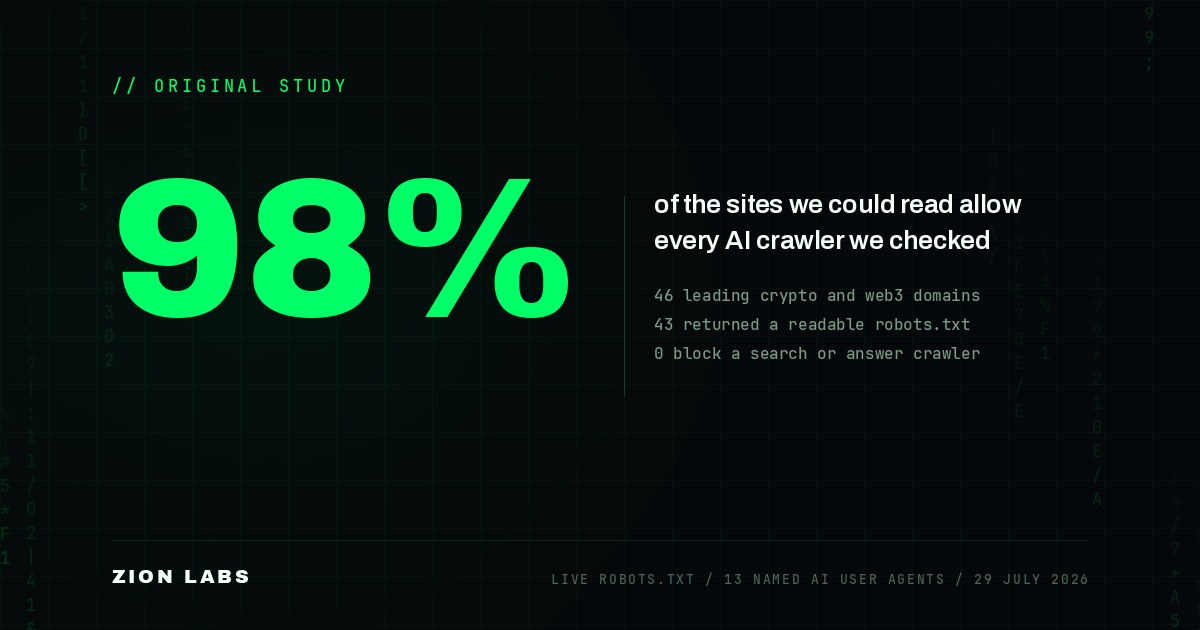
Access is solved here, exactly as the July index found: 48 of the 51 domains whose crawler rules we could read allow every AI crawler we check. Speed is fine: 37 of the 43 homepages we could read responded in under a second. The bottom three are the work, and all three are cheap. Across those 43 readable homepages:
- Not one carries a single HTML table. Zero out of 43, on a format that is among the most reliably quoted there is.
- 28 of 43 carry no date at all, neither visible on the page nor in markup, and only 2 carry both. An undated page is treated as unknown vintage, which for anything touching fees, regulation or supported assets is a reason to prefer a source that does carry a date.
- Only 5 of 43 carry FAQ or QA schema.
- 25 of 43 cost an engine more than 50,000 tokens to read the homepage. Time is not the problem in this vertical. Weight is.
trustwallet.com is the clean illustration: all three gates passed, allowed by every crawler we check, entity resolution 75, and still 56, because Token cost scores 0, Structure 25 and Extraction 50. Nothing is broken. The page gives an engine very little it can lift and charges a lot of tokens for it. coinledger.io, at 48, is the same story with 3,873 words, no tables, no question headings and no machine readable date.
Does a higher readiness score mean more AI citations?
No. In a separate enrichment pass over 42 of these companies, we compared readiness against how often each brand was cited as its own source in AI answers. The Spearman rank correlation was -0.034, which is no relationship at all. Over the same 42 companies, organic traffic, a rough proxy for brand size, correlated with the number of self citations at 0.873.
Brand size dominates, and anyone selling a readiness score as a citation forecast is overreaching. Readiness is a floor, not a ceiling. A site that returns zero words to a crawler cannot be cited from its own pages no matter how large the brand, which is precisely where several of the largest names in this cohort sit. Fixing that does not guarantee citations. Not fixing it forecloses them.
Does it matter where you crawl from?
Very much, and this caveat travels with every access claim in this piece. We measured the same cohort on 1 August from a datacenter IP under an earlier rubric, and ten domains could not be scored at all. From Cloudflare’s network on 4 August, eight of those ten returned a usable measurement: arbitrum.io, coinbase.com, koinly.io, cointracker.io, tokentax.co, uniswap.org, bitstamp.net and curve.finance. Two, revolut.com and sofi.com, remained unmeasurable from both vantage points. The sites did not change in three days. The network we asked from did.
So any statement about whether a crawler can reach a site is a statement about a specific requester from a specific network, and ours is not OpenAI’s. And an unscored result in this index is genuinely ambiguous evidence: it may mean a site is hostile to automated retrieval in general, or only that it is hostile to us. We report it as unmeasured because that is what it is. This comparison is about reachability only. The 1 August pass used a different rubric with different weights, so its scores are not comparable with these and none of them appear anywhere in this piece.
What the nine dimensions measure
Every dimension, its weight, and the trigger and cap on each of the three gates are documented on the Retrieval Readiness Score methodology page. Two details govern this pass specifically. Query alignment only scores when a buyer question is supplied, none was supplied here, so it is unscored for all 54 domains. And one site fails the mobile parity gate, kucoin.com at 42% of desktop text, which is unscored for unrelated reasons. The scorer is public and free at /tools/retrieval-readiness, and every row above can be re run against it.
What to fix first, in order
| # | Fix | Evidence from this cohort |
|---|---|---|
| 1 | Serve text. Server render or statically generate what describes you. An engineering ticket, not a content project | Under a hundred words to a plain fetch and nothing else here matters. Five ranked sites are capped at 25 by this |
| 2 | Unblock the answer crawlers in robots.txt. Run the free AI Crawler Audit | Two sites are capped at 43 by this alone, content work already done |
| 3 | Date your pages, visibly and in markup | 28 of 43 do neither. The cheapest 8 weighted points in the rubric |
| 4 | Put a real comparison table on the page | Zero out of 43 crypto and fintech homepages have one |
| 5 | Cut the payload. Weight is a retrieval cost and expensive documents get routed around | 25 of 43 cost an engine over 50,000 tokens |
| 6 | Fix entity resolution | Cohort mean 48.8. Most of these brands are a string to a model rather than a known thing |
Method, limits and how to check us
- Cohort: 54 crypto and fintech companies across seven segments, defined by hand in July 2026 and held constant since, not scraped from a listicle. One further domain was measured on 4 August 2026 and excluded from publication at the publisher’s discretion after measurement. Its exclusion changes no other row, and every figure in this piece is computed over the published 54.
- Instrument: the live Retrieval Readiness Score endpoint at scoring version 3, the same code path a reader gets.
- Method: one homepage fetch per domain from Cloudflare’s network, a second fetch with a mobile user agent for the parity check, robots.txt parsing for Access, and a public entity lookup for Entity Resolution.
- Ranking rule: only the 37 domains whose page we successfully fetched are ranked, for the reason set out above. The other eight are reported separately and excluded from every aggregate.
- Date: 4 August 2026, a snapshot of a single pass on a single day. Sites deploy and edge rules change, so any of these numbers can differ next week. That is why we publish the date and the raw file rather than a static grade.
- Scope: homepages only. Not a site wide audit, and a site with excellent documentation can score poorly here.
- Token counts are approximated at four characters per token.
- Earlier pass: our July scores used an earlier rubric with different dimensions and different weights. They are not comparable with these and none of them appear here.
- Raw data: the full per domain results, including every dimension score, gate outcome and page signal.
If you think a row is wrong, fetch the page yourself and count the words. We would rather be corrected than quoted incorrectly.
Run your own domain through the free Retrieval Readiness Score, no login required, or book an audit and we will benchmark you against your segment in this cohort.
Zion Labs researches how AI answer engines choose what to cite, and builds the tools and monitoring to help brands become the source they trust. Try the free tools or book a free audit.